About the author
Lauren Dobischok

Sexually transmitted infections (STIs) can present themselves in a variety of ways in women, and sometimes do not cause any symptoms at all. Symptoms that do appear can be vague or easily confused with other conditions, like urinary tract or yeast infections. Despite having fewer noticeable symptoms, untreated STIs in women can have serious health effects, such as chronic pain or infertility. That is why regular STI testing is an important part of women’s health, even if you are experiencing mild or no symptoms. If detected in a timely manner, most STIs are easily treatable and have no long-term health effects. This article summarizes the most common STI symptoms in women.
Chlamydia is a bacterial STI that can be transmitted through vaginal, oral, or anal sex. Although chlamydia is the most commonly reported STI in Europe, it often causes no symptoms, especially in women (CDC, 2025). This means some people may be infected without knowing it. When symptoms are present they include:
Want to get tested? Gain peace of mind by checking for chlamydia from home using Homed-IQ’s Chlamydia Test.
Gonorrhoea is caused by the Neisseria gonorrhoea bacterium and can infect the throat, cervix, uterus, rectum, and fallopian tubes in women. This STI can be transmitted by vaginal, oral, or anal sex and can cause pelvic inflammatory disease if left untreated for long periods of time. Gonorrhoea can also be passed from mother to child at birth, although pregnant women can prevent this by getting antibiotic treatment before birth. Symptoms of gonorrhoea in women include:
Trichomoniasis is an STI caused by the parasite Trichomonas vaginalis and can infect the vulva, vagina, cervix, or urethra in women. Trichomoniasis often does not cause symptoms, meaning people may not know they have it. However, it can cause discomfort during sex or when urinating (CDC, 2025). Once detected, it is easily treatable with antibiotics. If trichomoniasis causes symptoms, they include:
Syphilis is a bacterial infection spread by oral, anal, or vaginal sex, and can infect the vagina, rectum, or throat. Like other STIs, syphilis often does not cause any symptoms, although in the initial stage of infection it may cause a lesion (chancre) at the location where the syphilis entered the body. However, this lesion may be painless and more difficult to find on the vagina or rectum. Although syphilis is easily treated with antibiotics, it can cause serious inflammation and eventually organ damage if left untreated. Syphilis can also be passed from mother to child at birth without proper treatment, and cause premature birth, miscarriage, or other health problems in the infant, like brain damage or deafness (CDC, 2025). Symptoms of syphilis in women are:
Human Immunodeficiency Virus (HIV) is a virus that attacks the body’s immune system. The virus is present in blood, semen, vaginal fluid, and breast milk, and can infect someone if these fluids enter their bloodstream. HIV is most commonly transmitted through anal or vaginal sex or sharing needles, syringes, or other drug injection equipment. Women can be at higher risk for HIV for several reasons. One reason is because the receptive partner during anal or vaginal sex is at higher risk of infection than the insertive partner, as small tears in the genital tract are more likely, which allow the virus to the enter the bloodstream (NIH, 2021). You may not notice any symptoms of HIV other than a short flu-like illness a few weeks after infection, without any further symptoms or serious illness until months or years later. However, over time your body’s immune system will decline, making you susceptible to many types of illnesses. Although HIV is not curable, antiretroviral treatment allows those living with it to lead normal lives and not pass the virus to others, including from mother to child at birth. The most common symptoms of HIV in women include:
Hepatitis B is a liver infection caused by the hepatitis B virus. Hepatitis B is transmitted through infected body fluids, such as blood, semen, vaginal fluid, or breast milk. Like HIV, hepatitis B is spread when infected body fluids can enter the bloodstream, such as through small tears in the genitals during sex, childbirth, or contact with used needles. It cannot be transmitted through hugging, sneezing, coughing, or kissing (CDC, n.d.). An acute hepatitis B infection may cause flu-like symptoms, or no symptoms at all. Most acute hepatitis B resolves itself in 1 to 3 months, although in some cases the infection persists and becomes chronic. Symptoms of hepatitis B in women can include:
Herpes is an infection caused by the herpes simplex virus (HSV). Herpes is spread through any skin-to-skin contact with skin lesions, including kissing and vaginal, oral, and anal sex. HSV is categorized into two types: HSV-1 and HSV-2. HSV-1 is primarily transmitted by oral contact and can cause oral herpes, more commonly known as cold sores. HSV-1 can also infect the genitals during oral-genital contact. HSV-2 is an STI that exclusively infects the genitals. Both HSV-1 and HSV-2 infections can be asymptomatic and many people don’t know that they have it. When present, an initial outbreak of symptoms can occur 2 to 12 days after exposure to the virus. Sores from HSV occur where the infection enters your body. HSV can be passed from mother to child at birth, or more commonly, if someone who has cold sores kisses a baby. Symptoms of herpes in women are:
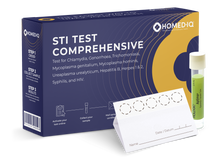
Would you like to perform a complete STI test panel from the comfort of home? Homed-IQ’s STI Test Comprehensive is a home test for the most common STIs, with laboratory-certified results available in a few days.
At-home testing with laboratory accuracy
Our medical laboratories operate according to strict European quality standards. All tests are analysed by ISO-certified partner labs, giving you reliable and professional results. With the comfort of your home.